I sat down on the wooden pew at the back of the sanctuary.
I had only one purpose for being there:
To audition them.
For the third time in one year, I had turned down a request to step in as Music Director at their church.
After saying no three separate times, I finally thought perhaps I should at least visit the room before making such dramatic conclusions.
At the time, I was praying for more bookings — concerts, songwriting opportunities, creative work that looked much more like what I imagined God and I had been discussing in my closet prayer times.
This request did not resemble any of it.
I had already left a church job once so I could focus full time on songwriting and concert ministry. Taking another church position felt suspiciously like going backward.
It checked none of my boxes.
Still, my husband was away that weekend at a college reunion in Florida, and I found myself thinking:
Why not at least sit in the room and listen?
So I went.
The orchestra in the service was really more of a small ensemble, but something about the sound caught me off guard.
The timpani with its low rumble.
The layered instruments.
The Irish pastor — serving double duty as both pastor and worship leader until they found the right person — leading with energy and conviction through Shout to the Lord.
And suddenly, without warning, I could barely sing.
Tears came quickly. Generously.
Which was inconvenient, because I was there to evaluate them, not fall apart in the back pew.
I remember thinking:
What on earth is happening to me?
Later that day, Tom had returned from Florida, and we sat in a restaurant comparing weekends — his involving sunshine and old college stories, mine involving unexpected tears and timpani.
Then, out of nowhere, I heard myself say:
“I want that job.”
He looked at me with his mouth and eyes equally wide.
“What?! You said you weren’t taking any more church jobs. What about songwriting? What about concerts?”
“I know,” I said. “I can’t explain it. But I think I want that job.”
At that point, I had never really worked with a live orchestra.
I had worked around orchestral sound — synthetic strings, woodwinds and brass layered through a keyboard in my home studio and later in a professional studio near Valley Forge — but that is very different from hearing instruments breathe in the same room.
Still, something about extra instruments had always appealed to me.
Years earlier, one of my musical heroes from the 1980s once described my piano playing in a way I never forgot:
“You are an orchestral pianist.”
At the time, I smiled politely, because I had no idea what she meant.
Now I think I do.
As a pianist serving in places with limited budgets, I had learned to compensate.
At special events, if there were no strings, no brass, no woodwinds — I filled the space myself.
Both hands constantly working.
Building atmosphere.
Creating movement.
Covering what wasn’t there.
And when I worked with worship bands, I had to learn the opposite skill:
Leave space.
Let guitars breathe.
Let bass do its job.
Stop acting like the piano owns the whole room.
Years later, when Portraits of White began — first with a 21-piece orchestra and eventually growing larger before shifting directions in 2019 — I became fascinated by orchestration in an entirely new way.
Every instrument had a role.
The woodwinds.
The strings.
The horns.
The percussion.
And yes… the oboe, which eventually became especially important since Kirstin entered the picture.
For the first time, on stage, I didn’t have to carry everything orchestrally at the piano.
Every instrument had its place, every entrance planned ahead of time — all of it written down in the score.
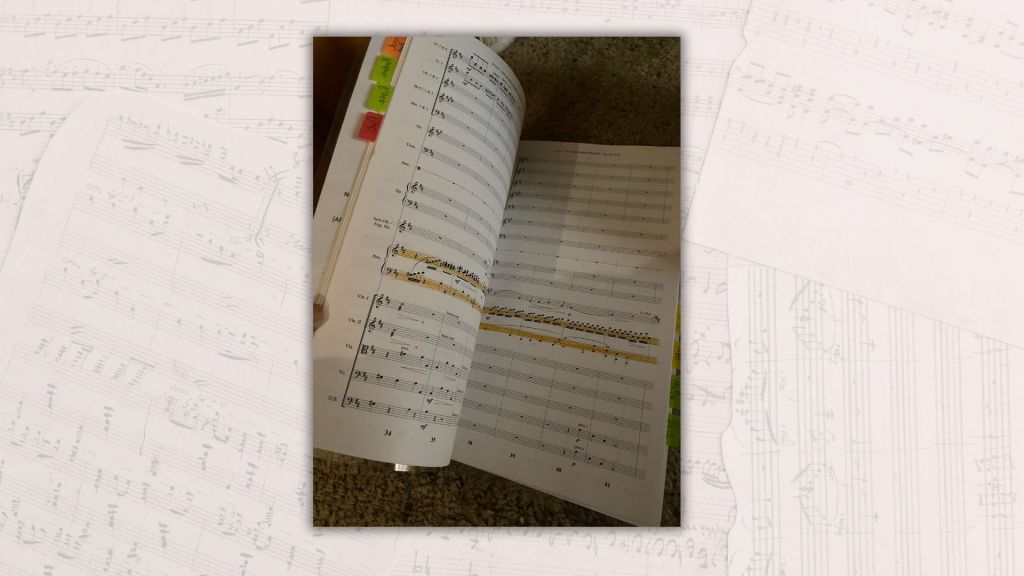
Recently, I had the full score printed for Double Keyed’s upcoming album.
My own score to study, mark, stare at, and slowly digest like someone trying to read a language while also preparing to fly to London.

The first time I ever held a real conductor’s score was in 2014, when Portraits of White debuted.
I still have that score.
At the end of that first sold-out performance, I asked the conductor to autograph it.
He had taken a chance on me.
He had listened to my vision — a concert built around story, music, and orchestra — and called it viable before either of us knew what kind of orchestra would actually materialize in Pennsylvania.
A trusted local musician agreed not only to serve in the orchestra, but to help contract players. Through a remarkable network, a beautiful orchestra came together.
When the concert ended, I handed the conductor his score and asked him to sign it.
He wrote:
“Let’s do it again.”
That simple sentence told me everything.
We had not embarrassed ourselves.
And more than that — something had begun.
That same conductor would later plant the seed for what is now our London Symphony Orchestra project.
So now, as I study this new score for Double Keyed, I find myself deeply grateful.
How strange that a single yes that didn’t fit my plan — a visit to a sanctuary, a timpani roll that stirred something deeper than expected — could quietly become part of something much larger.
I took the church job.
And stayed six years.
At the time, I thought I was simply saying yes to a local season of service.
I had no idea I was also saying yes to sounds, textures, and longings that would one day help prepare me to sit with a score for the London Symphony Orchestra.
It seems the heart recognizes its future long before the mind has words for it.
 Frances Drost
Leave a comment